
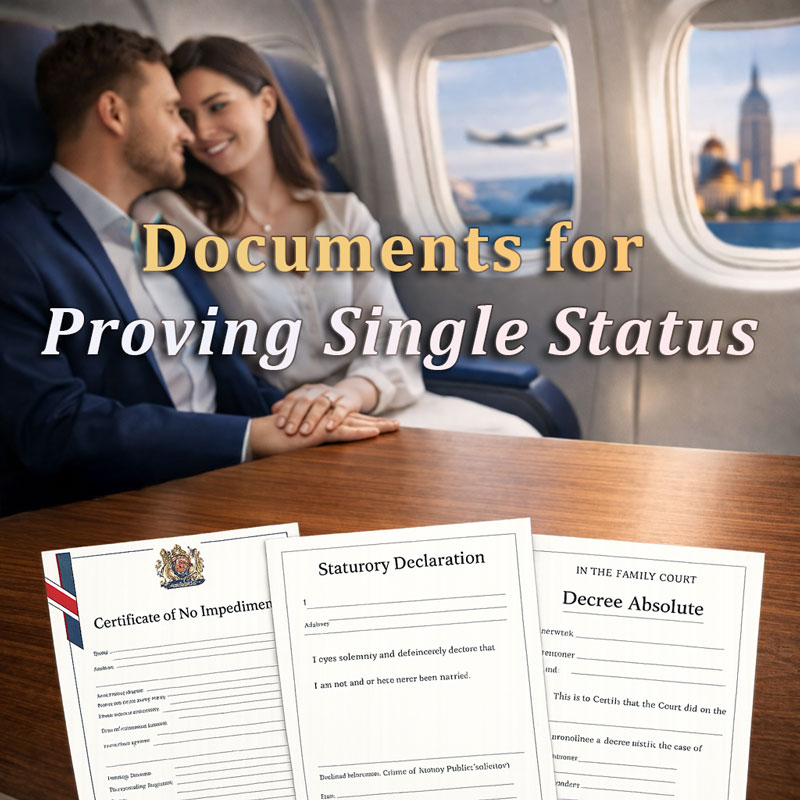

How do you prove you are single?
If you are getting married outside the UK, one of the first questions you may face is this: how do you prove you are single and legally free to marry? The answer depends on the country where the wedding will take place, the authority asking for the document, and whether you are British, divorced, widowed, or using an alternative to a Certificate of No Impediment.
In practice, overseas authorities usually ask for one of three things:
- Certificate of No Impediment
- No Trace of Marriage document
- Statutory Declaration confirming you are not married
Some countries also ask for supporting papers such as a decree absolute if you have been married before.
This guide explains the difference between each document, when each one is used, and how to get a Hague Apostille in the UK so your paperwork can be accepted abroad.
What document proves you are single for marriage abroad?
The most suitable document depends on what the foreign authority has asked for. If you are a British citizen planning to marry a specific person in a specific country, the usual document is a Certificate of No Impediment. If you cannot get one, or if the foreign authority asks for something different, they may accept a No Trace of Marriage document or a Statutory Declaration of Single Status.
The key point is simple: there is no single universal document called a “single status certificate” that works everywhere. Different countries use different wording and different rules, so always confirm the exact requirement before ordering anything.
What is a Certificate of No Impediment?
A Certificate of No Impediment, often shortened to CNI, is an official document issued through the register office process in the UK. It confirms that there is no legal objection to your proposed marriage or civil partnership abroad.
This is usually the right document if:
- you are a British citizen
- you are planning to marry abroad
- the ceremony is with a specific person in a specific country
- the overseas authority has specifically asked for a CNI
A CNI is generally linked to a planned marriage abroad rather than being a broad proof of single status for any purpose. That is why some register offices state clearly that it is not the same as a general single-status document.
How do you get a Certificate of No Impediment?
You normally apply through your local register office in the district where you live. You will usually need to give notice, provide proof of nationality, address, age, and any supporting marital status documents.
If you have been married before, you may need to show:
- your decree absolute or final order
- a death certificate if you are widowed
- evidence of name changes if your documents do not match
Because local rules and appointment systems vary, the safest starting point is the official GOV.UK getting married abroad guidance.
Does a Certificate of No Impediment need solicitor or notary public certification?
Usually, no. A Certificate of No Impediment is already an official UK-issued document, so for apostille purposes it will often go straight to legalisation without needing prior solicitor certification.
However, this is where many people get caught out. Some foreign authorities want more than just the apostille. They may also ask for:
- notarial certification
- a sworn statement or affidavit
- translation
- embassy or consular legalisation after the apostille
So while the CNI itself often does not need a solicitor or notary before apostille, the destination country may still require an extra step. If you are unsure, read our guide on Apostille vs notarisation or contact us for tailored advice.
What is a No Trace of Marriage document?
A No Trace of Marriage document, sometimes called a Letter of No Trace, is a letter confirming that the relevant records show no trace of a marriage for the person named during a stated period.
This document is often used when:
- you have been asked for a single-status document but are not following the CNI route
- the foreign authority will accept a record search letter instead of a CNI
- you are not eligible for a CNI
- the authority wants evidence of record searches rather than notice-based marriage paperwork
It is important to understand that a No Trace letter is not identical to a CNI. A CNI is about no legal objection to a proposed marriage abroad. A No Trace letter is about there being no marriage record found within a given period.
Who usually needs a No Trace of Marriage document?
This depends on the country and the authority asking. In some cases, foreign nationals living in the UK, or applicants who are not using the CNI route, may be told to obtain a No Trace letter instead. Some authorities accept it for single-status purposes, while others do not.
That is why this document should only be ordered once you have checked exactly what the overseas authority will accept.
Does a No Trace of Marriage document need solicitor or notary public certification?
Usually, no before apostille, because it is an official record-based document. In many cases, it can go directly for apostille legalisation as issued.
That said, if the receiving country asks for a notarised package, translation, or embassy legalisation, extra certification may still be needed later in the chain.
What is a Statutory Declaration confirming you are not married?
A Statutory Declaration is a formal written statement where you declare that you are single, not currently married, and free to marry. It is commonly used when a foreign authority asks for an affidavit, affirmation, declaration of single status, or when a CNI is not available or not accepted.
This option is often useful for:
- countries that do not accept a CNI
- cases where a more flexible declaration is required
- situations where the authority wants a sworn statement
- people who need to explain previous marriage, divorce, widowhood, or name changes in one document
Does a Statutory Declaration need solicitor or notary public certification?
Yes. This is the document in this group that clearly requires prior witnessing or certification. A statutory declaration must be signed before a person authorised to administer oaths, usually a solicitor or notary public.
For apostille purposes, the declaration usually needs the signature and stamp of the solicitor or notary so the FCDO can legalise it.
In simple terms:
- Certificate of No Impediment: usually apostille only
- No Trace of Marriage document: usually apostille only
- Statutory Declaration: solicitor or notary first, then apostille
Should you use a solicitor or a notary public for a statutory declaration?
That depends on the receiving country. A solicitor may be enough in many apostille cases. But if the overseas authority specifically asks for notarisation, or the document is part of a more formal international legal process, a notary public is usually the safer option.
If you are not sure which route your country requires, read our guide on Apostille vs notarisation before you proceed.
What is the difference between a Certificate of No Impediment, No Trace of Marriage document, and Statutory Declaration?
Here is the simplest way to understand it:
Certificate of No Impediment
An official register-office route for a planned marriage abroad. Best for British citizens who are marrying a specific person in a specific country.
No Trace of Marriage document
A records search letter showing no marriage record found for a stated period. Often used when a general single-status document is requested, or when a CNI is not the correct route.
Statutory Declaration
A sworn statement made by you and witnessed by a solicitor or notary public. Often used when the foreign authority asks for a declaration, affidavit, or flexible statement of civil status.
In other words, these documents may all help prove civil status as single, but they are not interchangeable. The wording on the request from the overseas authority matters.
How do you get an apostille for these documents in the UK?
The Hague Apostille is issued by the UK Foreign, Commonwealth & Development Office. It confirms that the signature, seal, or stamp on your UK document is genuine so the document can be used internationally in Hague Convention countries.
Step 1: Confirm exactly what the foreign authority wants
Before ordering anything, confirm the required document name, whether translation is needed, and whether apostille alone is enough.
Step 2: Obtain the correct document
Get the Certificate of No Impediment, No Trace letter, statutory declaration, or decree absolute that matches the request.
Step 3: Add solicitor or notary certification if required
This is especially important for statutory declarations, affidavits, and any document the foreign authority wants notarised.
Step 4: Submit the document for apostille
You can apply directly through the FCDO or use a professional service. If speed matters, see our apostille processing times guide and our apostille cost guide.
Step 5: Check whether embassy legalisation is also required
If the destination country is not part of the Hague Apostille Convention, an apostille may not be the final step. You may also need embassy or consular legalisation after the apostille.
Ready to start? Order your apostille online here.
Does a decree absolute need an apostille?
If you have been married before, a foreign authority may ask for your decree absolute or final order as evidence that your previous marriage has legally ended.
This is an important distinction:
- a decree absolute proves a previous marriage ended
- it does not usually replace a CNI or statutory declaration when proof of current freedom to marry is required
In many marriage-abroad cases, the decree absolute is a supporting document rather than the main single-status document.
If the overseas authority wants to see it, they may also ask for it to be apostilled. If you do not have a copy, you can request one through the official GOV.UK decree absolute service.
Do you need a solicitor or a notary public?
This is one of the most common questions, and the answer depends on the document:
- Certificate of No Impediment: normally no solicitor or notary needed before apostille
- No Trace of Marriage document: normally no solicitor or notary needed before apostille
- Statutory Declaration: yes, it must be witnessed by a solicitor or notary public
- Decree absolute: usually apostilled as an official court document or acceptable certified version, depending on what you hold
If the foreign authority specifically says notarised, use a notary public. If they simply need a witnessed declaration that can be apostilled, a solicitor may be enough in some cases. When in doubt, get advice before paying for the wrong service.
Frequently asked questions about proving single status with UK documents
Can I use a single status certificate instead of a Certificate of No Impediment?
Sometimes, yes. But the term “single status certificate” is often used loosely. The authority may actually want a CNI, a No Trace letter, or a statutory declaration. Always check the exact wording they require.
Can foreign nationals in the UK get a Certificate of No Impediment?
Often no. In many cases, the CNI route is limited to British citizens, which is why some applicants are directed towards a No Trace letter or a sworn declaration instead.
Can a statutory declaration be apostilled?
Yes. But it must first be signed before a solicitor or notary public so that the signature can be recognised for legalisation.
How long does the apostille process take?
Times vary depending on whether you apply directly or use a professional service, and whether you also need notarisation, translation, or embassy legalisation. You can read more in our apostille processing times guide.
Do I need embassy legalisation after the apostille?
If your destination country is outside the Hague Apostille Convention, possibly yes. In those cases, apostille is usually not the final step.
What should I do first?
First, check with the marriage authority, wedding venue, embassy, or local registrar in the destination country. Once you know the exact document name they require, the apostille process becomes much easier.
Final thoughts
Proving single status is very important. When you are getting married abroad, proving single status is not about ordering the first document that sounds right. It is about matching the correct UK document to the exact overseas requirement.
For some people, that will be a Certificate of No Impediment. For others, it will be a No Trace of Marriage document or a Statutory Declaration. If you have been married before, your decree absolute may also need to be included and apostilled.
If you already have the correct document and need fast legalisation, Order Apostille Now. If you are unsure which route applies to your case, contact Ace Apostille and we will help you understand the next step.
Which document has the overseas authority asked you for: a CNI, a No Trace letter, or a statutory declaration? That one detail usually determines the whole process.
Read More
 ACRO Police Check: How to get one quickly and avoid rejection