
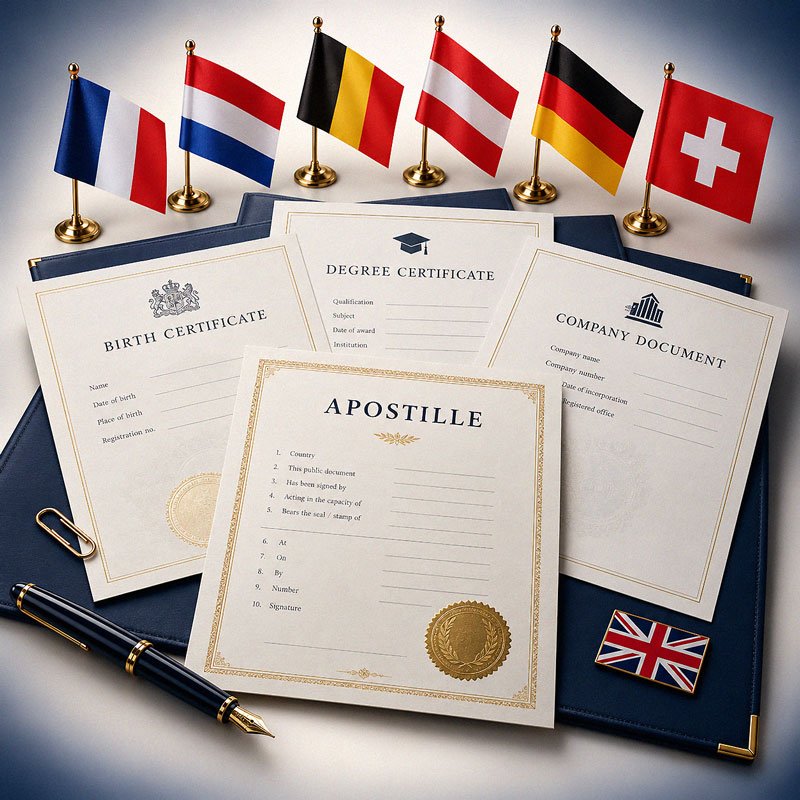

If you need to present a UK document in France, the Netherlands, Belgium, Austria, Germany or Switzerland, you may need a UK Apostille issued by the Foreign, Commonwealth & Development Office. However, the rules vary by country. The document type, its intended use and the requirements of the receiving authority all matter.
Birth certificates, marriage certificates, ACRO Police Certificates, degree certificates, court orders, powers of attorney and company documents are among the most frequently apostilled UK documents for use in these countries.
There are also some important exceptions. For example, British birth, marriage and death certificates generally do not require legalisation for Belgium. France also exempts certain categories of UK documents under existing international agreements.
This guide explains which UK documents commonly need an apostille, when solicitor certification may be required and whether you are likely to need a translation.
Do UK documents need an apostille for use in Europe?
A UK document may need an apostille when a public authority, court, university, employer, bank, notary or business in another country needs confirmation that its UK signature, stamp or seal is genuine.
The apostille is attached by the UK Legalisation Office, part of the Foreign, Commonwealth & Development Office (FCDO). It authenticates the origin of the document. It does not confirm that every statement contained in the document is true.
France, the Netherlands, Belgium, Austria, Germany and Switzerland all participate in the Hague Apostille Convention. Therefore, when an apostille is required, further legalisation through the destination country’s embassy is not normally necessary.
However, Hague Convention membership does not mean that every document automatically requires an apostille. Bilateral agreements, local procedures and exemptions may remove the requirement for certain documents.
| Destination country | Is a UK apostille normally required? | Important point |
|---|---|---|
| France | Depends on the document | Several categories of UK documents are exempt under international agreements. Notarial documents and many administrative documents commonly require an apostille. |
| Netherlands | Frequently | Civil-status certificates, certificates of no impediment, qualifications, medical documents and ACRO certificates generally require an apostille. |
| Belgium | Depends on the document | British birth, marriage and death certificates are generally exempt. Most other British documents require an apostille when authentication is requested. |
| Austria | Frequently | The precise requirement depends on the application. Foreign civil-status and professional documents are commonly apostilled. |
| Germany | Depends on the authority | German authorities decide whether they need an apostille, certified copy, German translation or qualification recognition. |
| Switzerland | Frequently | An apostille is normally the only authentication required when the Swiss authority asks for legalisation of a UK public document. |
Ready to order your Apostille? Start your Apostille order here.
Why might you need an apostille for a UK document?
People usually need to legalise UK documents because they are moving, working, studying, marrying or conducting business overseas. The requirement often appears at the final stage of an important application, which can make an unexpected request for an apostille particularly stressful.
Common reasons include:
- Visa, immigration or residence applications
- Family reunification and citizenship applications
- Marriage or civil partnership overseas
- Registration of a UK birth, marriage, divorce or death
- University admission and qualification recognition
- EU Blue Card and skilled-worker applications
- Overseas employment and background checks
- Company formation, branch registration and business transactions
- Property purchases and powers of attorney
- Inheritance, probate and international court proceedings
- Banking, compliance and identity verification
Which UK documents are most commonly apostilled?
The most frequently requested documents fall into four main groups: civil-status documents, criminal-record documents, educational documents and commercial or legal documents.
| Document type | Common overseas use | Usual UK preparation |
|---|---|---|
| Birth certificate | Marriage, residence, citizenship and family applications | An official GRO or registry-issued certificate can normally go directly to apostille |
| Marriage certificate | Family reunification, name changes and marriage registration | An official certificate can normally go directly to apostille |
| Death certificate | Inheritance, probate, pensions and estate administration | An official certificate can normally go directly to apostille |
| Certificate of No Impediment | Getting married abroad | Normally submitted as the original official certificate |
| Divorce order or court judgment | Remarriage and recognition of a UK divorce | The route depends on whether the document has a verifiable (ink-signed or wet-stamped) court seal or signature |
| ACRO Police Certificate | Visas, residence, citizenship and overseas employment | The original certificate can normally go directly to a paper apostille |
| Degree certificate or transcript | Employment, university admission and professional recognition | Often requires solicitor or notary public certification and, in some cases, verification with the university |
| Passport or driving licence copy | Banking, company, property and identity procedures | A copy normally requires solicitor or notary certification |
| Power of attorney | Property, court and commercial transactions | Requires witnessing, solicitor certification or notarisation before apostille |
| Companies House document | Opening a branch, company registration and due diligence | The route depends on how the document was issued and what the recipient has requested |
| Employment or medical letter | Work, immigration, insurance and professional applications | Must carry a suitable signature and may require prior certification |
If you are uncertain about your document, Ace Apostille can check it before submission. Learn more about apostille and solicitor certification.
Apostille for UK documents used in France
Not every UK document needs an apostille for use in France. France’s official treaty guidance provides exemptions for several categories of British documents, including many civil-status records and certain judicial documents. Other documents, including notarial acts, privately signed documents carrying an official certification and many administrative documents, commonly require an apostille.
Documents that may require an apostille for France include:
- UK degree certificates and academic qualifications
- ACRO Police Certificates and other criminal-record documents
- Notarial deeds and notary-certified documents
- Powers of attorney
- Affidavits and statutory declarations
- Company and commercial documents
- Employment, medical and professional documents
- Certified copies of passports and identity documents
Does a UK birth or marriage certificate need an apostille for France?
Many UK civil-status documents benefit from an exemption under agreements between France and the United Kingdom. This means that an apostille may not be legally required for a UK birth, marriage or death certificate presented in France.
However, the French mairie, prefecture, notaire, court or other organisation handling your case should confirm its exact requirements. The way the document will be used can affect how it is classified.
Do UK documents need a French translation?
French authorities may require an authorised French translation of a document written in English. Before ordering a translation, ask the receiving authority whether it must be completed by a certified translator or a court-authorised sworn translator.
In our experience, if you are requested to provide a translation done by a sworn translator “traducteur assermenté”, you should look for a court-approved translator directly in France.
The UK Apostille is already issued in 3 languages: English, French and Spanish. This means that the Apostille page might not require translation.
Checking this first can prevent you from paying for a translation that the authority will not accept.
Apostille for UK documents used in the Netherlands
Many UK documents require a paper or electronic apostille before they can be used in the Netherlands. Official Dutch guidance specifically lists civil-status records, certificates of unmarried status, diplomas, professional certificates, medical documents and ACRO Police Certificates.
Frequently apostilled documents for the Netherlands include:
- Birth, marriage, divorce and death certificates
- Certificates of No Impediment or unmarried status
- Degree certificates, diplomas and professional qualifications
- Academic transcripts
- Medical reports signed by a registered doctor
- Original ACRO Police Certificates
- Powers of attorney
- Company and commercial documents
Do English documents need translation in the Netherlands?
No, not usually. The Dutch Government states that documents written in English do not generally need to be translated for use in the Netherlands. This can make the process simpler and less expensive than in countries where a sworn local-language translation is routinely required.
You should always double-check the requirements with the requesting party.
Are there any Dutch exemptions?
Documents issued by a British embassy or consulate do not normally need to be legalised for the Netherlands. A British Certificate of Naturalisation is also listed as an exception because it does not carry a signature suitable for legalisation.
The Dutch authority can still check the authenticity or contents of a document after legalisation. An apostille authenticates its origin, not the accuracy of every statement it contains.
Apostille for UK documents used in Belgium
British birth, marriage and death certificates do not generally require an apostille to be recognised by a Belgian authority. This exemption comes from a bilateral agreement between the United Kingdom and Belgium.
This is easily overlooked and can lead applicants to pay for legalisation they may not need.
You should always double-check the requirements with the requesting party.
Which UK documents need an apostille for Belgium?
Other British documents generally require an apostille when a Belgian authority asks for legalisation. Examples may include:
- ACRO Police Certificates
- Degree certificates, diplomas and transcripts
- Powers of attorney
- Affidavits and statutory declarations
- Notarised documents
- Passport copies
- Company documents
- Employment and medical documents
- Court or divorce documents not covered by an exemption
Once an eligible UK document has received the FCDO apostille, further legalisation at the Belgian Embassy in London is not normally required.
Do UK documents need translation for Belgium?
A translation may be required into Dutch, French or German, depending on the Belgian authority and region receiving the document. Ask the commune, court, university, employer or other requesting organisation whether it requires a Belgian sworn translator.
Apostille for UK documents used in Austria
UK documents are commonly apostilled for Austrian residence, employment, marriage, education and business procedures. Austrian guidance confirms that the apostille replaces full diplomatic legalisation between Hague Convention countries.
Common UK documents used in Austria include:
- Birth and marriage certificates
- Certificates of No Impediment
- Divorce orders
- Degree certificates and academic transcripts
- Professional qualifications
- Employment references
- ACRO Police Certificates
- Certificates of Incorporation and company documents
- Powers of attorney
Which documents are used for an Austrian Red-White-Red Card or EU Blue Card?
Applicants may be asked for degree certificates, professional-training documents, employment references, proof of university status and other evidence of their qualifications. The Austrian authority may request authenticated documents when it needs to verify them.
Do not assume that every supporting document requires an apostille. Confirm the list with the Austrian embassy, immigration authority or caseworker before arranging legalisation.
Do documents for Austria need a German translation?
It depends on the procedure. Austrian skilled-migration guidance allows many documents in German or English, but civil-status, marriage, court and local administrative procedures may require a German translation.
The authority may also specify who is authorised to translate the document. Check this before ordering the translation.
Apostille for UK documents used in Germany
UK documents may require an apostille for German marriage, residence, professional recognition, court and business procedures. Requirements can differ between a Standesamt, local immigration office, university, professional body, court or commercial registry.
Frequently requested documents include:
- Birth and marriage certificates
- Certificates of No Impediment
- Divorce orders and court judgments
- Degree certificates, diplomas and transcripts
- Professional qualifications and licences
- Employment references
- ACRO Police Certificates
- Company documents and commercial-register evidence
- Powers of attorney and notarised documents
Does a UK degree need an apostille for Germany?
Not automatically. For regulated professions, professional recognition may be compulsory. For some work visas and EU Blue Card applications, applicants must demonstrate that their foreign qualification is comparable to a German qualification.
This may be done through the Anabin database or a Statement of Comparability from the Central Office for Foreign Education. The responsible German authority will decide whether it also needs an apostilled degree, a certified copy or additional university verification.
UK academic documents frequently require solicitor certification before apostille.
Do documents for Germany need a certified translation?
German authorities frequently request translations prepared by a publicly appointed or authorised translator. The responsible authority decides whether a translation is required and whether a translation completed outside Germany will be accepted.
Always check before arranging the translation. German requirements can differ by federal state and by application type.
Apostille for UK documents used in Switzerland
When a Swiss authority requests authentication of a UK public document, a UK apostille is normally sufficient. The document does not usually need further legalisation through the Swiss Embassy because both countries participate in the Hague Apostille Convention.
Common UK documents used in Switzerland include:
- Birth, marriage and death certificates
- Certificates of No Impediment
- Divorce and court documents
- ACRO Police Certificates
- Degree certificates and professional qualifications
- Employment and medical documents
- Company documents
- Powers of attorney
- Probate and inheritance documents
Do UK documents need translation for Switzerland?
Translation requirements depend on the canton and the organisation receiving the document. A document may need translation into German, French or Italian. Some institutions accept English documents, while others require a certified translation into the local official language.
Ask the relevant cantonal authority, civil registry, university, employer, bank or notary to confirm its requirements.
Does my document need solicitor certification before apostille?
Some UK documents can go directly to apostille because they already contain an official signature, seal or stamp that the Legalisation Office can verify. Other documents require certification by a UK solicitor or Notary first. In our experience, for use in Switzerland, the safest approach is to have the document certified by a Notary Public.
Documents that can often go directly to apostille
- Official UK birth certificates
- Official UK marriage certificates
- Official UK death certificates
- Original ACRO Police Certificates
- Certificates of No Impediment
- Sealed court documents
- Certain government-issued documents
- Certain Companies House certificates
Documents that often require prior certification
- Degree certificates and academic transcripts
- Passport and driving licence copies
- DBS certificates
- Powers of attorney
- Contracts and private agreements
- Bank statements and utility bills
- Employment letters
- Medical letters
- Private company documents
- Documents printed from digital files
The exact certification depends on what the receiving authority has requested. If its instructions say “notarised”, solicitor certification may not be sufficient.
Can I use an e-Apostille in these countries?
An e-Apostille may be suitable if the receiving organisation accepts electronic legalisation and the document can be issued or certified as an eligible digitally signed PDF.
However, a paper apostille is required for several important document types. The UK Government does not issue e-Apostilles for:
- Birth, marriage, death, civil partnership or adoption certificates
- Other General Register Office certificates
- ACRO Police Certificates for England and Wales
- DBS certificates
- Scottish and Northern Irish disclosure certificates
- Fingerprint certificates
Do not choose an e-Apostille simply because it sounds faster or more convenient. First confirm that the organisation receiving your document will accept it.
How does the UK apostille process work?
- Confirm the overseas requirements. Ask whether the receiving authority needs an original, certified copy, apostille, notarisation or translation.
- Check the document. Determine whether it can go directly to apostille or needs solicitor certification, notarisation or university verification.
- Place your order online. Use the Ace Apostille online order form.
- Send us the document. Documents can be posted, sent by courier or delivered to one of our offices.
- We arrange the apostille. Ace Apostille submits the eligible document through the FCDO Legalisation Office.
- Receive your completed document. We offer secure UK and international return-delivery options, including delivery to France, the Netherlands, Belgium, Austria, Germany and Switzerland.
How much does a UK apostille cost?
Ace Apostille’s service starts from £79 per document.
Additional charges may apply where the document also needs:
- Solicitor certification
- University award verification
- Notary Public certification
- Certified or sworn translation
- International courier delivery
Simple solicitor certification starts from £20 per document. University award verification is charged from £50 per document where it is required. Notarial work, complex documents and translations are quoted according to the document and destination.
Contact Ace Apostille if you would like us to check your document and confirm the likely route before you order.
How quickly can Ace Apostille legalise my document?
Our next-day apostille service can usually have an eligible document ready on the next working day when the correct document reaches us by 11:00 am on a working day.
The full turnaround will depend on:
- Whether the document is already suitable for apostille
- Whether solicitor or notary certification is required
- Whether an educational award must be verified
- Whether translation is required
- Delivery times to and from our office
If you have an urgent visa, marriage, university or business deadline, send us a copy of the document and the instructions from the receiving authority before posting the original.
Common apostille mistakes that cause delays
- Assuming every European country has the same rules: France and Belgium have important exemptions that do not apply in the Netherlands.
- Apostilling the wrong document: A photocopy, downloaded PDF or short-form certificate may not meet the recipient’s requirements.
- Using solicitor certification when notarisation was requested: These are different legal acts.
- Arranging translation too early: The translator may need to translate both the document and its apostille.
- Ignoring document-age requirements: An apostille does not make an old police or civil-status certificate current.
- Choosing an e-Apostille without checking acceptance: Some authorities only accept the physical document with a paper apostille.
- Assuming the apostille proves the document’s contents: It authenticates the relevant signature, seal or stamp.
Frequently asked questions
Do UK documents automatically need an apostille after Brexit?
No. Brexit did not create one universal rule requiring every UK document to be apostilled. The requirement depends on the destination country, document type and receiving authority. Existing bilateral agreements can also provide exemptions, particularly for certain documents used in France and Belgium.
Does a UK birth certificate need an apostille in Europe?
It depends on the country. An official UK birth certificate generally requires an apostille for the Netherlands and is commonly apostilled for Austria, Germany and Switzerland when authentication is requested. British birth certificates are generally exempt from legalisation in Belgium. France also provides exemptions for many UK civil-status records.
Read our complete guide to getting a UK birth certificate apostilled.
Does a UK marriage certificate need an apostille?
A marriage certificate may need an apostille for residence, family reunification, a name change or registration of a UK marriage abroad. The Netherlands commonly requires one. Belgium generally exempts British marriage certificates, and France provides exemptions for many UK civil-status documents.
Learn more about an apostille for a UK marriage certificate.
Does an ACRO Police Certificate need an apostille?
An original ACRO Police Certificate commonly requires a paper apostille for visa, residence, citizenship and overseas-employment applications. It cannot receive a UK e-Apostille. The authority receiving the certificate will also decide how recently it must have been issued.
See our ACRO Police Certificate apostille service.
Does a UK degree need an apostille for Europe?
A UK degree may need an apostille for university admission, professional recognition, skilled-worker immigration or an EU Blue Card application. Academic documents often require solicitor certification and may require verification directly with the awarding institution before apostille.
Does a UK apostille expire?
The apostille itself does not normally expire. However, the document or application may have a separate validity requirement. Police certificates, civil-status records, medical documents and company extracts are sometimes required to have been issued within a particular period (like, issued in the last 3 months).
Can the same apostilled document be used in several countries?
A UK apostille is not normally limited to one Hague Convention country. However, each receiving authority can impose its own rules concerning the document’s age, format, translation and intended purpose. An authority may also retain the original document.
Can I order a UK apostille while living overseas?
Yes. You can place your order online and send your UK document to Ace Apostille from overseas. Once completed, we can return it to an address in the UK or arrange tracked international delivery.
Order your UK apostille online
Using the wrong document, certification or translation can delay a visa, marriage, university application or business transaction. Ace Apostille checks your document, arranges any necessary solicitor certification and submits it for the official UK apostille.
We help customers legalise UK documents for use throughout France, the Netherlands, Belgium, Austria, Germany and Switzerland.
Order your UK apostille online or contact our team if you need help confirming the correct process.
Read More
 Proving Single Status with UK Documents